Multi-Material Topology Optimization

with General Convex Polytopal Constraints

Dohyun Kim

joint work with P. Gangl, B. Keith, B. S. Lazarov, T. M. Surowiec

Division of Applied Mathematics, Brown University

Engineering Conference · 2026
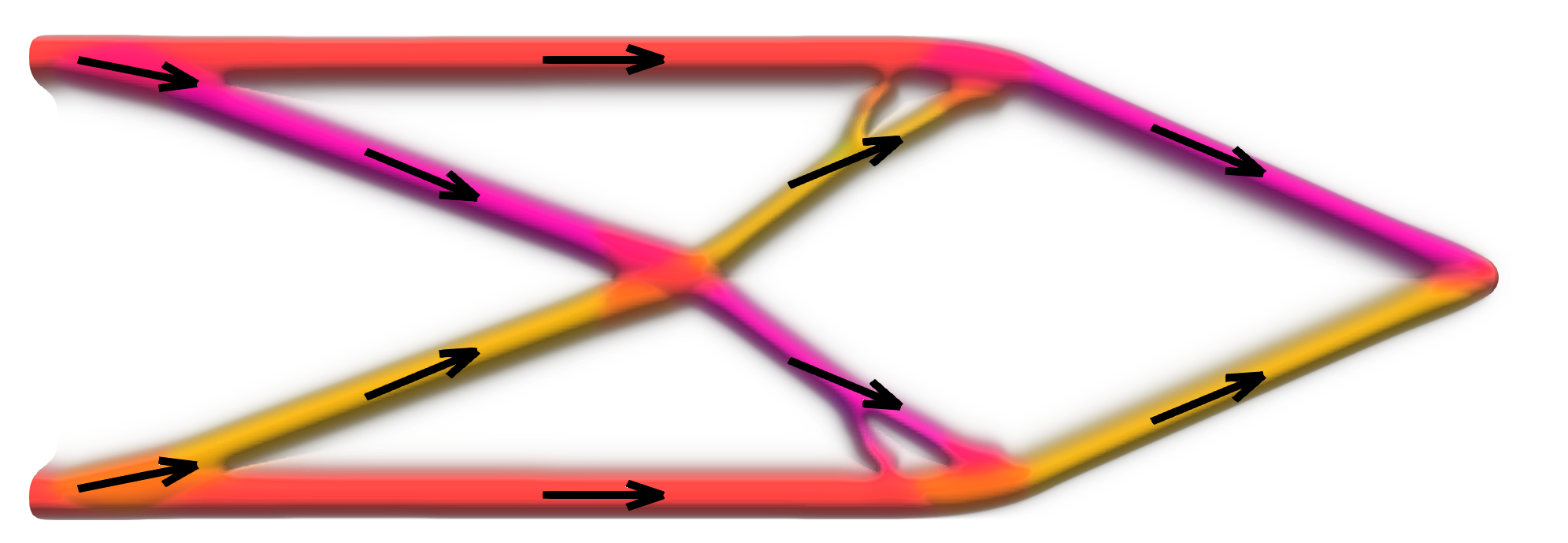
orthotropic — per-point fiber angle
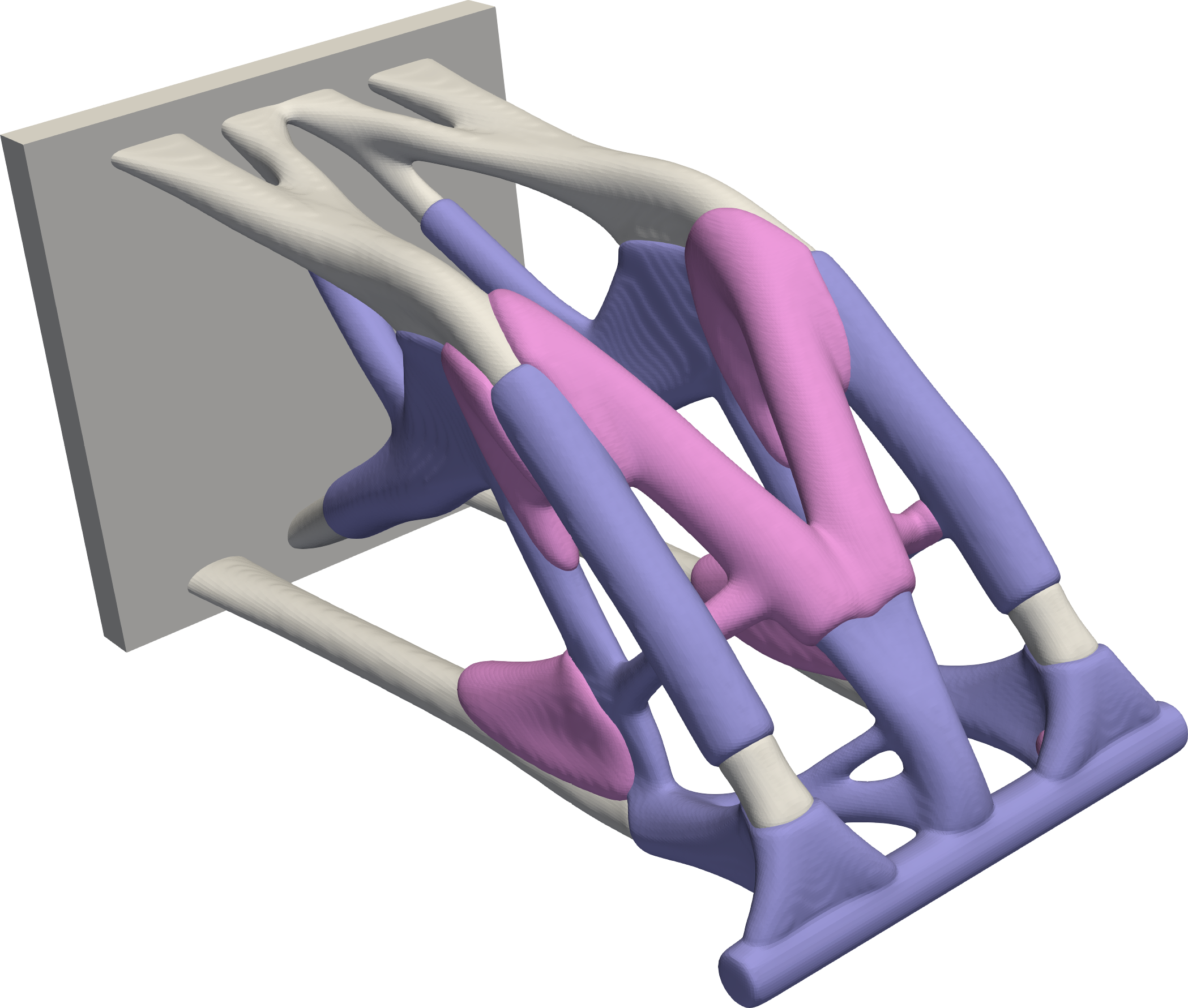
3D compliance, three materials

Topology optimization — one material, then many

Where should material go?
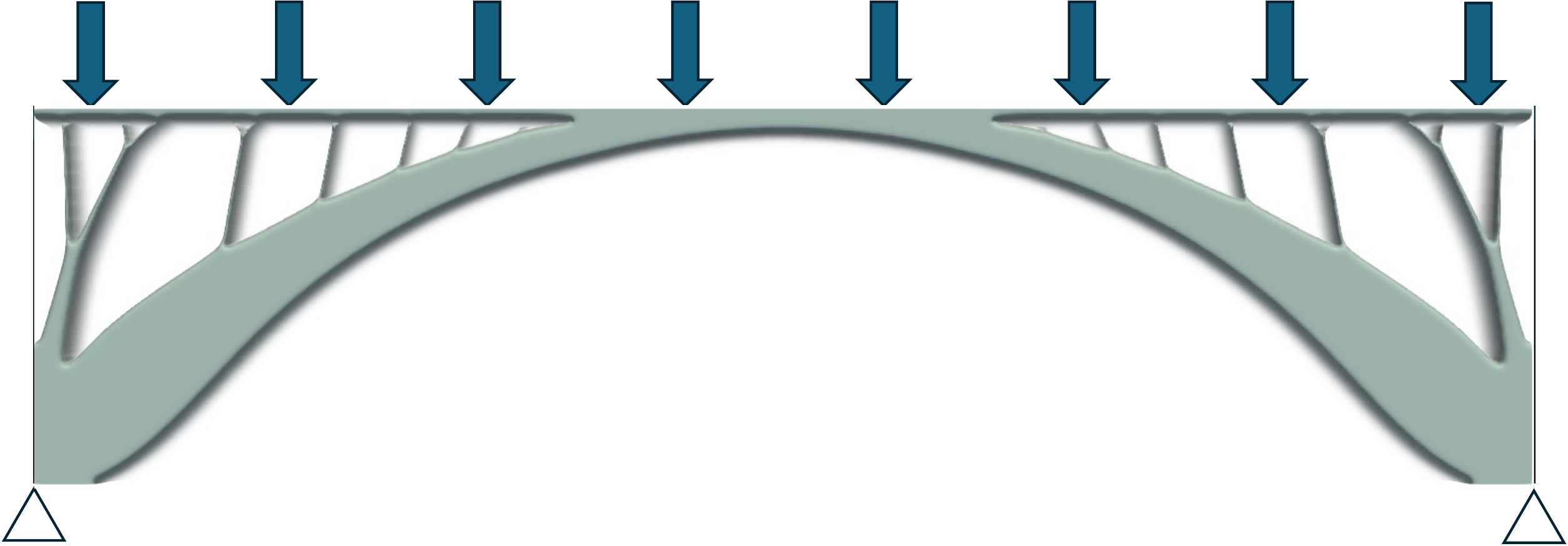
$$ \min_{\rho}\ J(\rho)=\int_\Omega f\cdot u(\rho)\,\dd x \quad \text{s.t.}\ \ \rho(x)\in[0,1],\ \ \int_\Omega \rho\,\dd x = V|\Omega| $$
  • pointwise bound + one volume budget (linear)
  • gradients: one adjoint solve

…and which material?
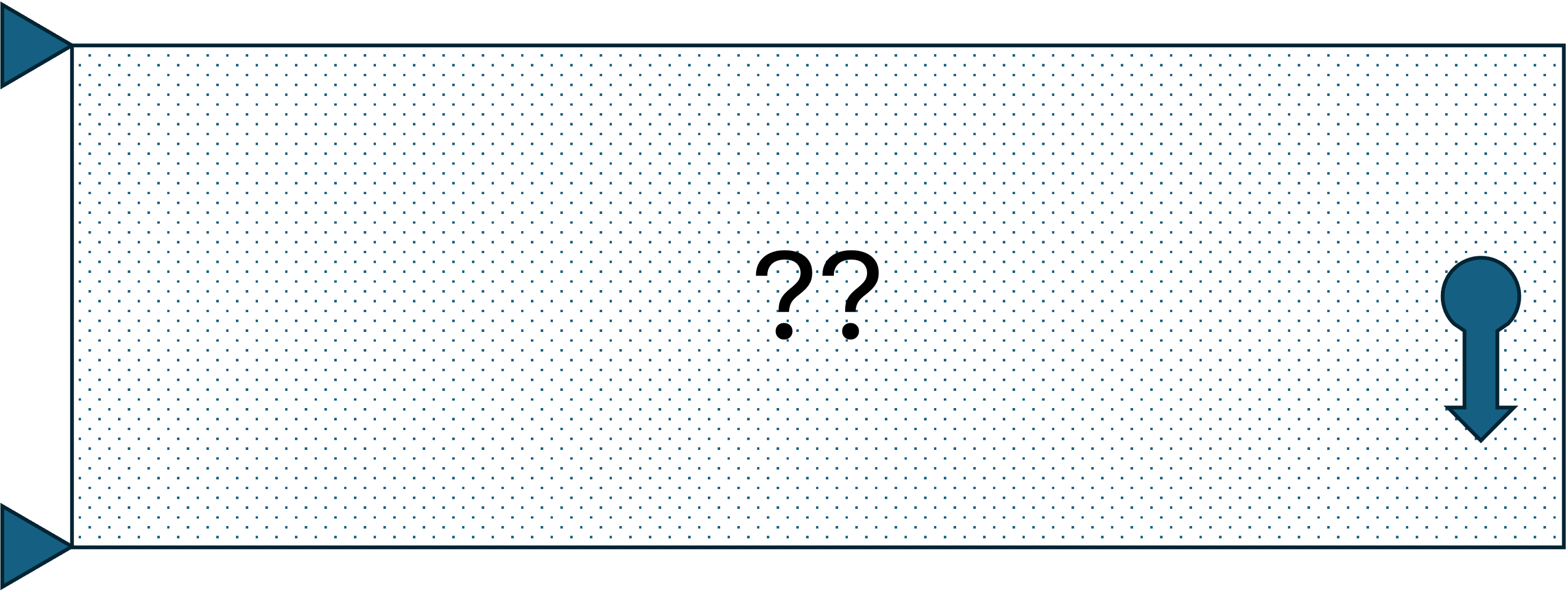
  • $n$ phases $\{\mathsf{C}_i\}$ — stiff / light / cheap, or fiber angles
  • one-of-$n$ choice at every point,
    per-phase budgets (still linear)
  • relax the discrete choice
Brown · Applied MathMulti-Material TO via Mirror Descent

SiMPL in one slide — mirror descent

SIOPT '25
SMO '25
Projected gradient → mirror descent (two edits)
given $\rho^0$;  for $k=0,1,2,\dots$ $\rho^k \leftarrow \mathrm{sigmoid}(\psi^k)$  // latent → primal state + adjoint solve → $g^k=\nabla J(\rho^k)$ $\rho^{k+1} \leftarrow \mathrm{proj}_{[0,1]}\!\big(\rho^k - \alpha\, g^k\big)$ $\psi^{k+1} \leftarrow \psi^k - \alpha_k\, g^k$
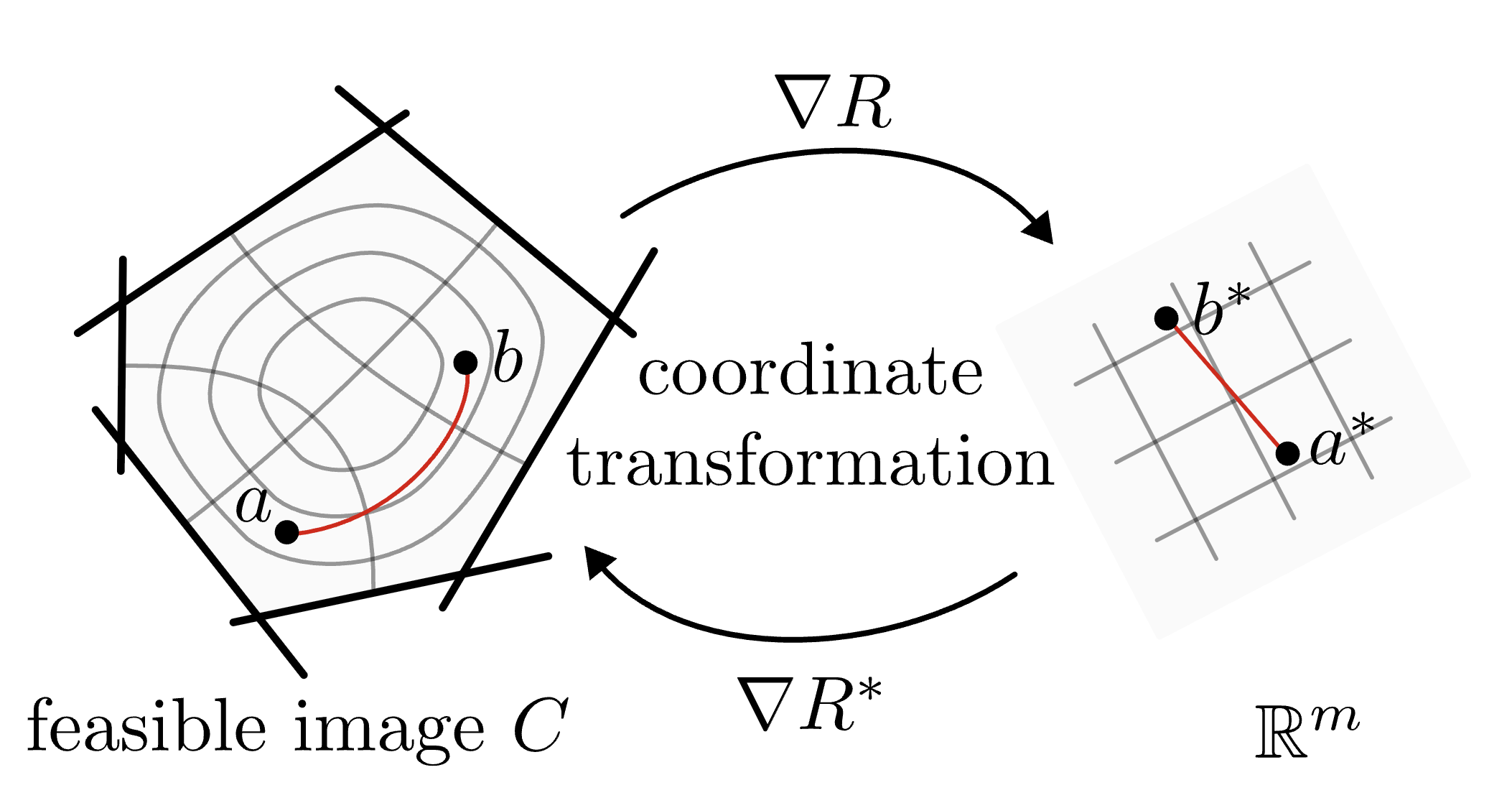
Each step solves a subproblem
$$ \rho^{k+1} \;=\; \argmin_{\rho}\ \langle g^k,\rho\rangle \;+\; \tfrac{1}{\alpha_k}\,D_R(\rho,\rho^k) $$
first-order optimality:
$\nabla R(\rho^{k+1}) \;=\; \nabla R(\rho^k) \;-\; \alpha_k\, g^k$
latent variable $\psi \coloneqq \RED{\nabla R}(\rho)$:
$\BLUE{\psi^{k+1}} \;=\; \BLUE{\psi^{k}} \;-\; \alpha_k\, g^k$
inverse relation:
$\rho \;=\; \BLUE{\nabla R^*}(\psi) \;=\; \mathrm{sigmoid}(\psi)$
  • no projection
  • $\psi\to\pm\infty$ ⇒ $\rho\to\{0,1\}$ exponentially
  • $\alpha_k \approx \kappa_{\text{geom}} / \kappa_{\text{obj}}$
    secant guess, then backtrack
  • mesh-independent iteration counts

Keith, Kim, Lazarov, Surowiec — SIAM J. Optim. 2025; Struct. Multidisc. Optim. 2025 (SiMPL).

Brown · Applied MathMulti-Material TO via Mirror Descent

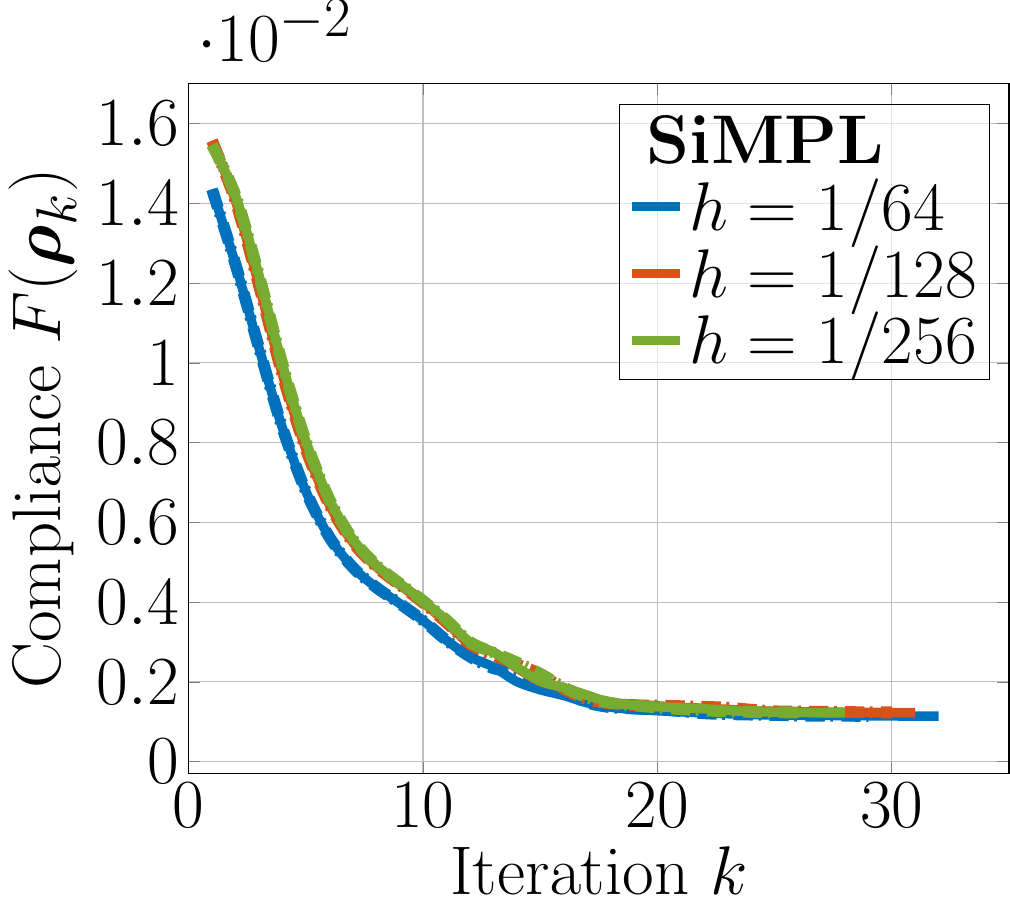
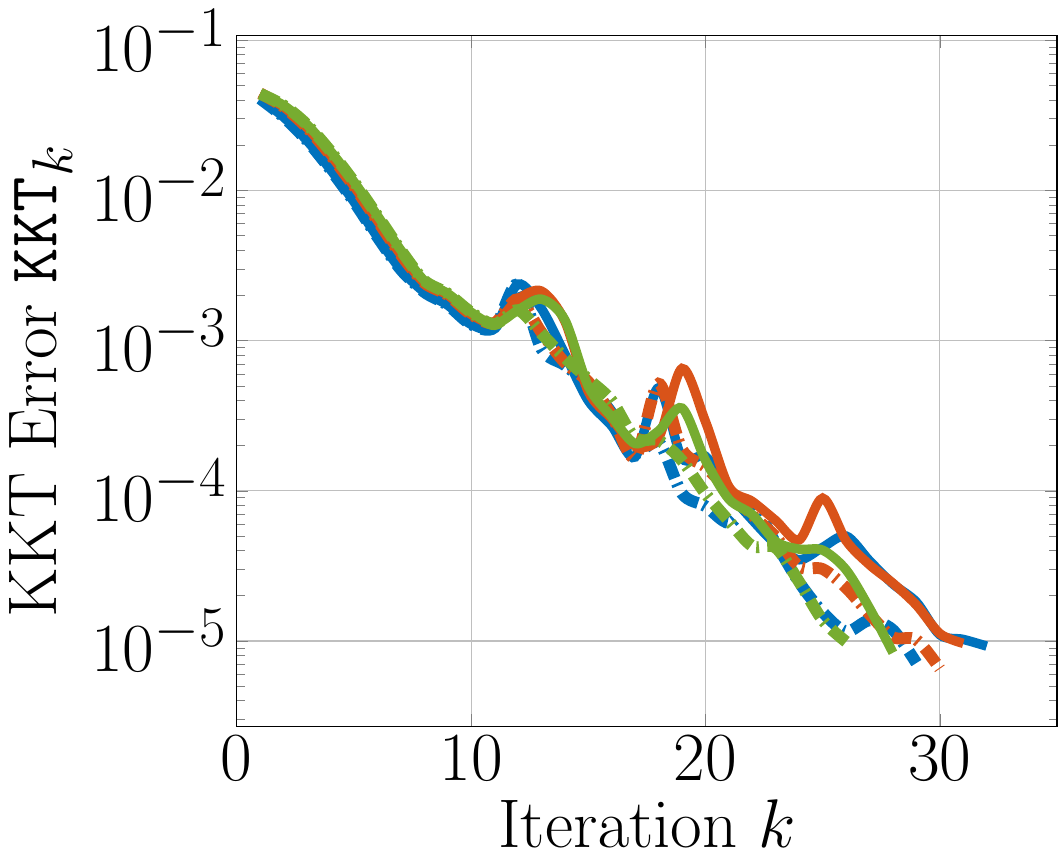
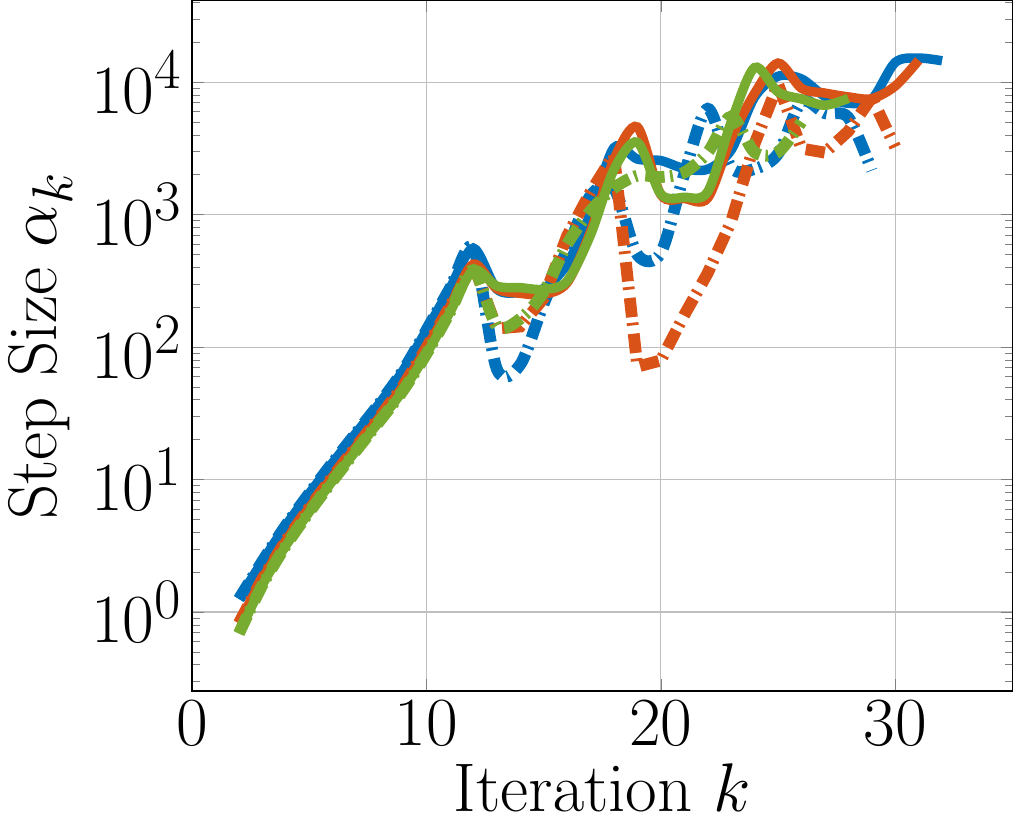
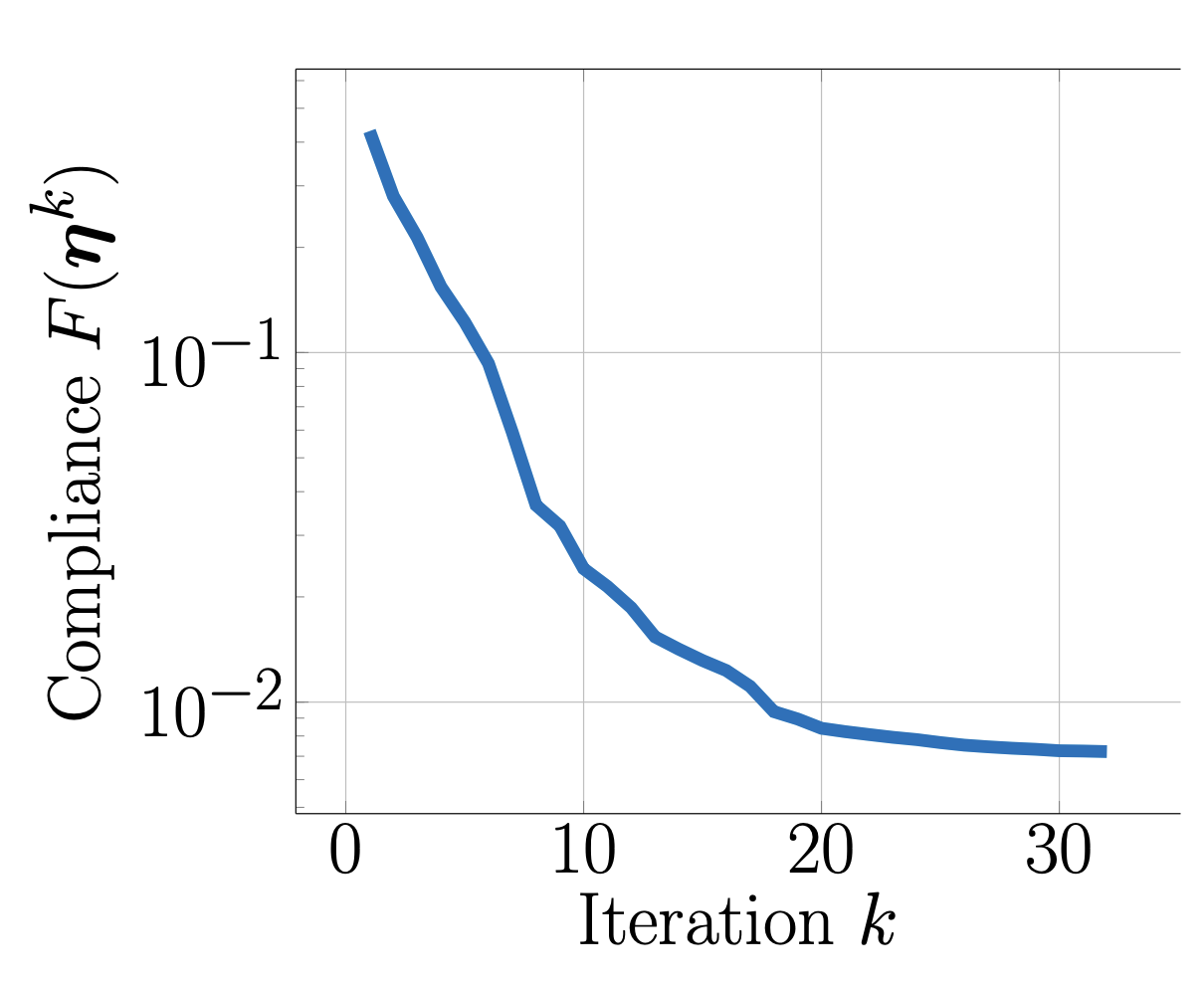
What convergence looks like

Curves for $h = 1/64,\ 1/128,\ 1/256$ lie on top of each othermesh-independent iteration counts, measured.
Brown · Applied MathMulti-Material TO via Mirror Descent

Multi-material: is the simplex the natural choice?

Conventional: lift to fractions

  • weights $\lambda\in\Delta^{n-1}$, design $\rho=\sum_i\lambda_i v_i$
  • $n$ discrete angles ⇒ $n$ fields for a 2-D quantity
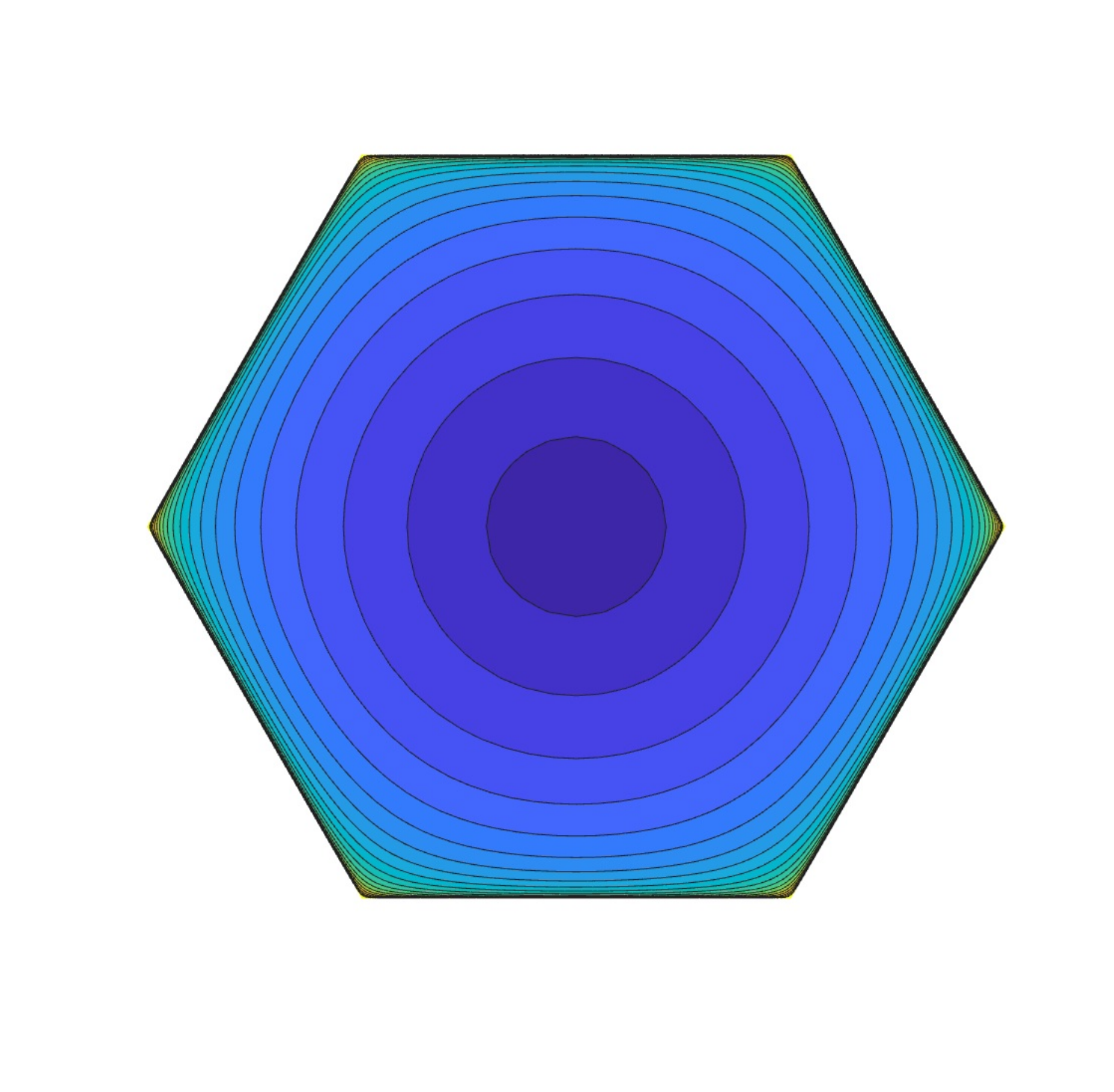
materials = vertices of a polytope $P=\mathrm{conv}\{v_i\}$

Orthotropic: the angles already live in 2-D
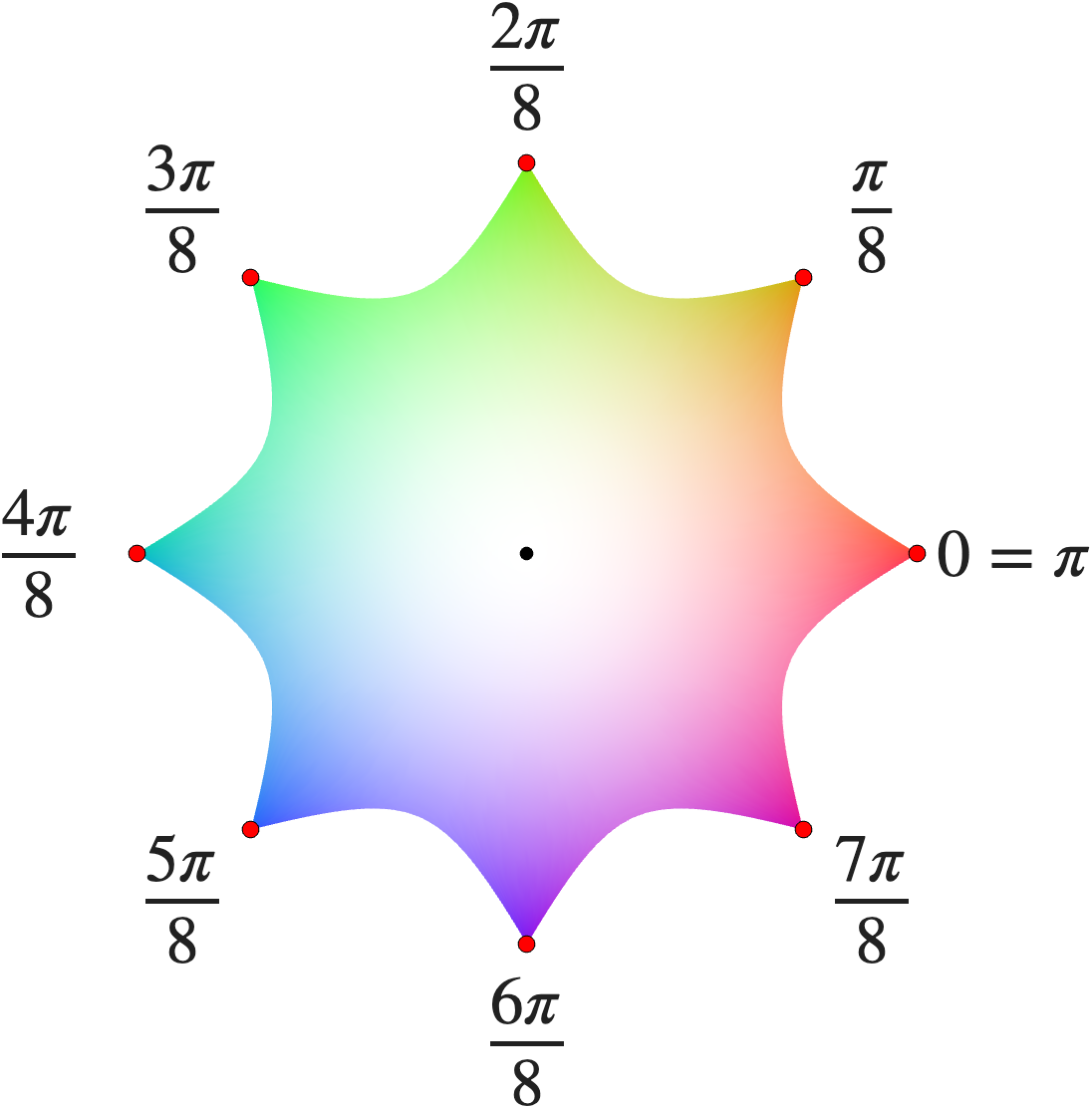
double-angle plane: vertex $k$ sits at $2\theta_k$
  • more angles = finer polygon, still dim 2
Brown · Applied MathMulti-Material TO via Mirror Descent

Entropy handles Geometry (Hidden in $D_\RED{R}$)

CMA '25

A Legendre entropy $R:C\to \mathbb{R}^n$ gives a bijection $\nabla R^*:\mathbb{R}^d\to \mathrm{int}\,C$

Key idea
A Legendre entropy for a general polytope $P=\mathrm{conv}\{v_1,\dots,v_n\}\subset \mathbb{R}^n$, with closed-form $\nabla R^*$.
Brown · Applied MathMulti-Material TO via Mirror Descent

The polytopal entropy

Collect the vertices in $V=[v_1\ \cdots\ v_n]$ and push the Gibbs entropy through $V$:

$$ R^*(\psi) \;=\; \log\!\sum_{k} \exp\!\big(v_k^{\!\top}\psi\big) \qquad\Longrightarrow\qquad \BLUE{\rho \;=\; \nabla R^*(\psi) \;=\; V\,\mathrm{softmax}(V^{\!\top}\psi)} $$
  • $R$ = Gibbs entropy inf-projected onto $P$
  • closed-form $\nabla R^*$ and Hessian — cheap at every quadrature point
  • recovers the classics: box → sigmoid, simplex → softmax
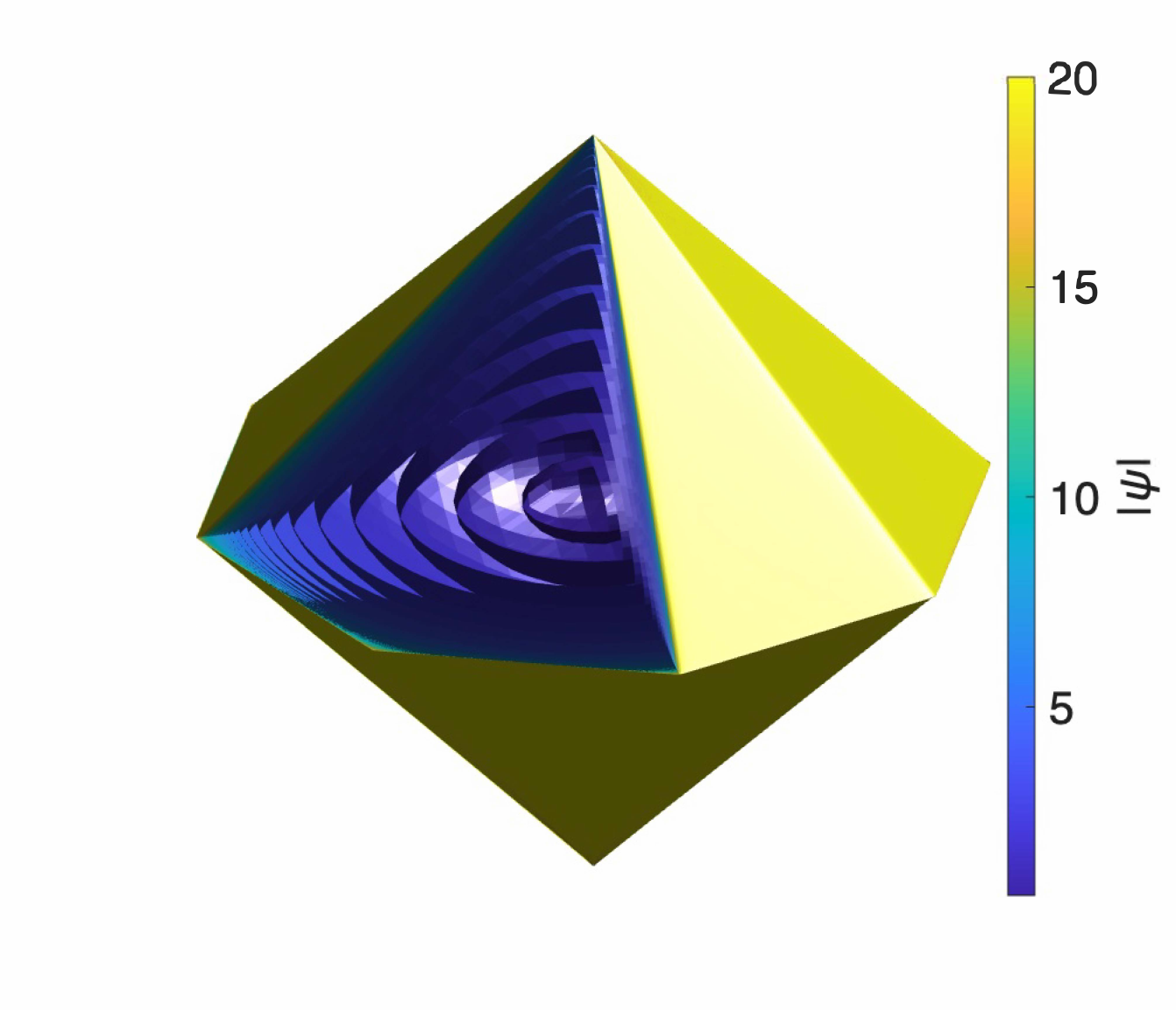
Octagon-base polytope in $\mathbb{R}^3$
void + orthotropic + isotropic
Intuition
$|\psi|\to+\infty \;\iff \lambda=\text{softmax}(V^T\psi)\to e_i\;\iff\; \rho\to\text{vertex}$
Brown · Applied MathMulti-Material TO via Mirror Descent

The algorithm — one line changes

SiMPL, multi-material edition
given $\psi^0$;  for $k=0,1,2,\dots$ $\rho^k \leftarrow$ $\mathrm{sigmoid}(\psi^k)$$\BLUE{V\,\mathrm{softmax}(V^{\!\top}\psi^k)}$  // the only change state + adjoint solve → $g^k=\nabla J(\rho^k)$ $\alpha_k\leftarrow$ secant curvature guess $\psi^{k+1} \leftarrow \psi^k - \alpha_k\, g^k - \mu_k$, backtrack $\alpha_k$ until $J$ decreases // $\mu_k$: a small dual solve for the global linear constraints
Everything else is inherited
Adaptive step size, monotone backtracking, KKT gap
— from single-material SiMPL.
  • first-order, gradients only
  • feasible at every iterate
  • $\psi(x)\in \mathbb{R}^d$, not $\mathbb{R}^n$
Brown · Applied MathMulti-Material TO via Mirror Descent

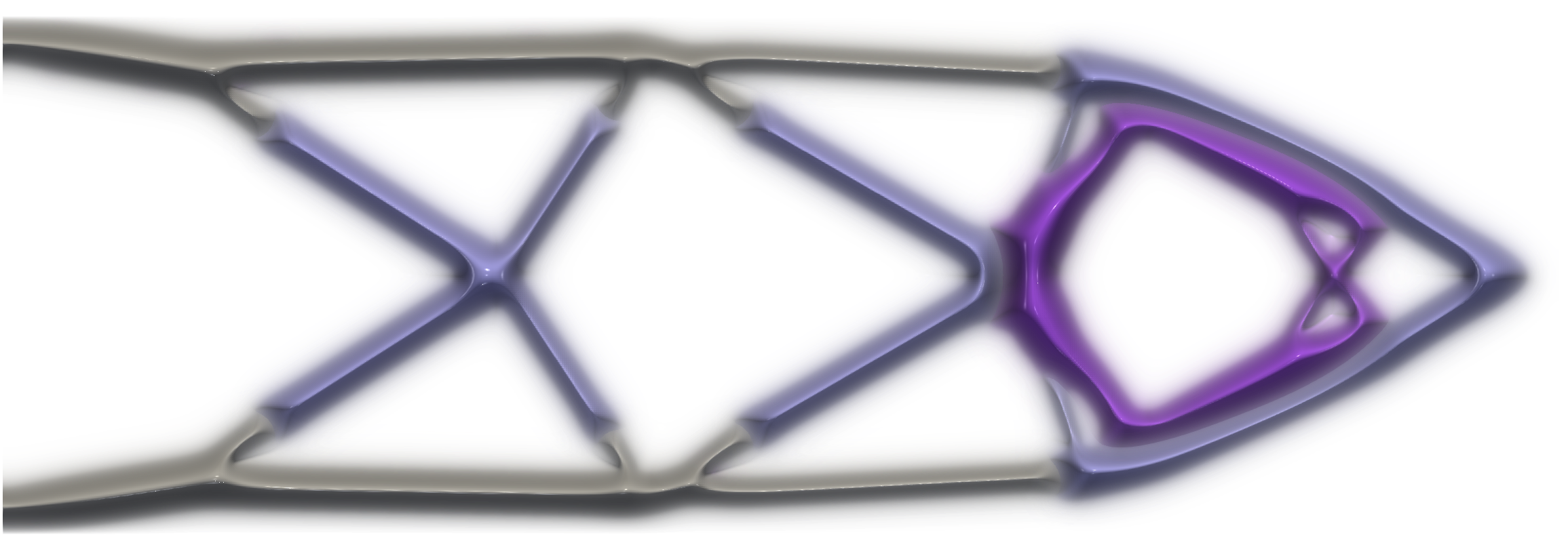
Results — 2D multi-material

Brown · Applied MathMulti-Material TO via Mirror Descent

Results — 3D and orthotropic compliance

3D, three materials 47 it
orthotropic cantilever, 8 discrete fiber angles — color = angle 38 it
Brown · Applied MathMulti-Material TO via Mirror Descent

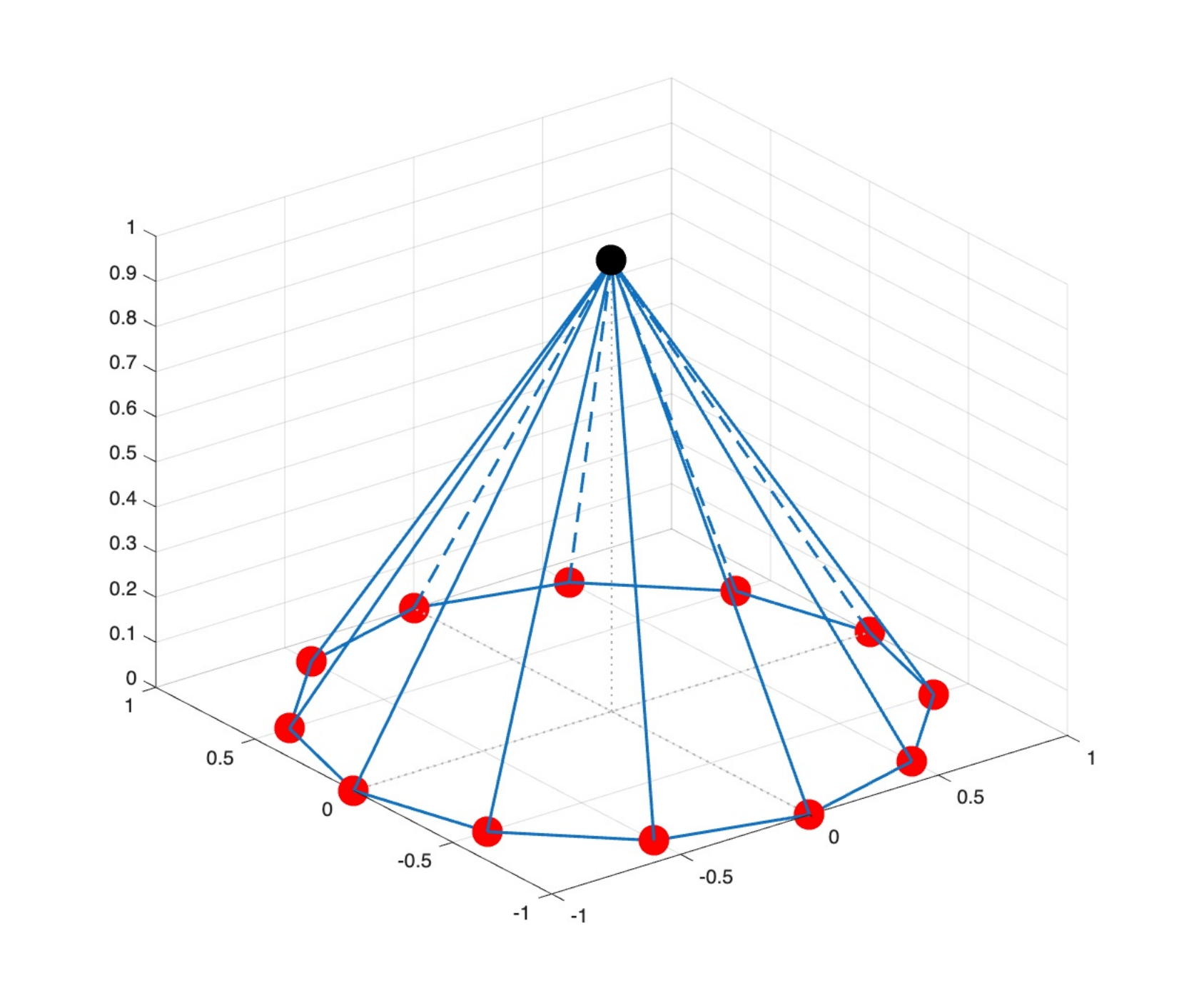
Continuous angles — the limit of the polygon
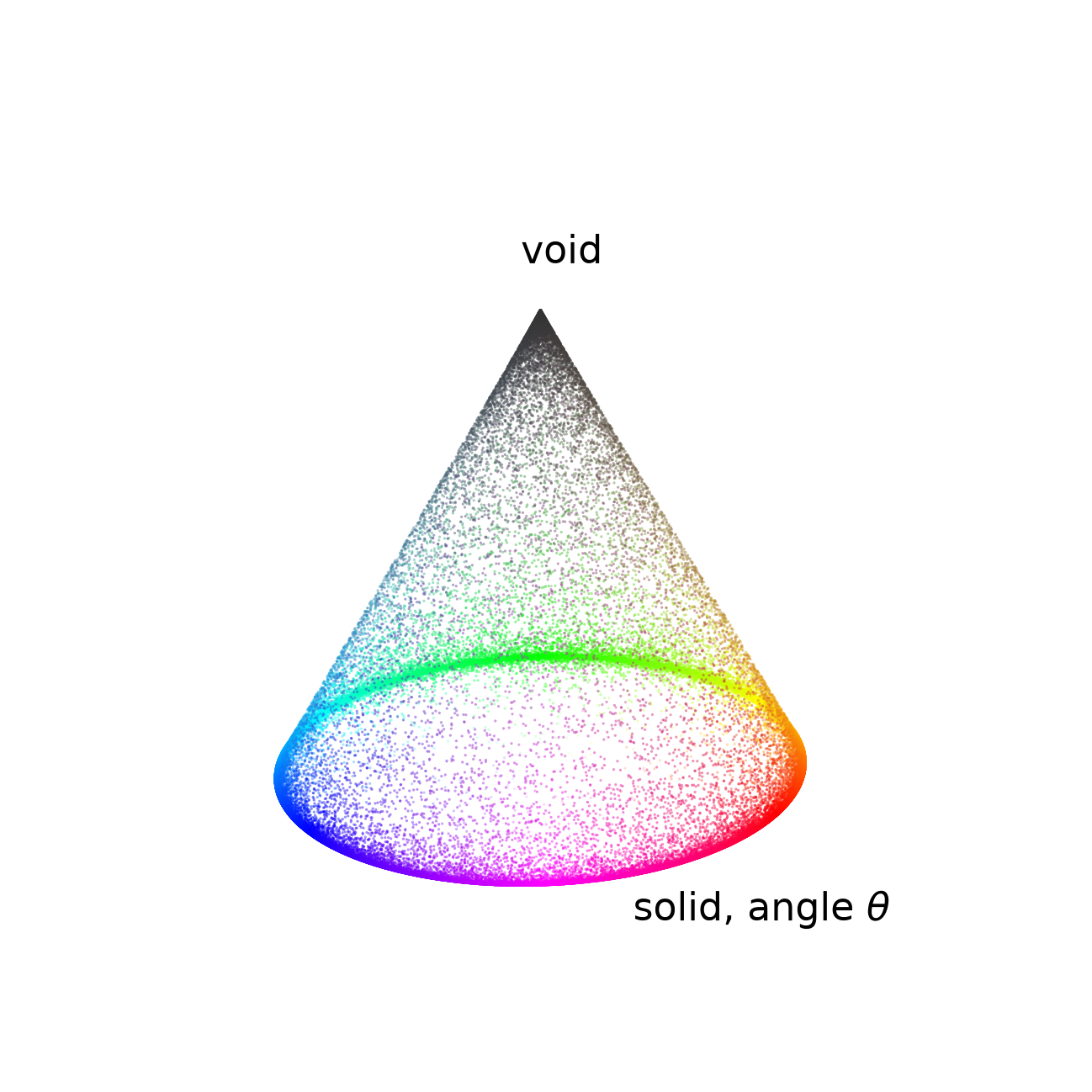
cone = latent ball mapped by $\nabla R^*$:
rim = solid at any $\theta$, apex = void
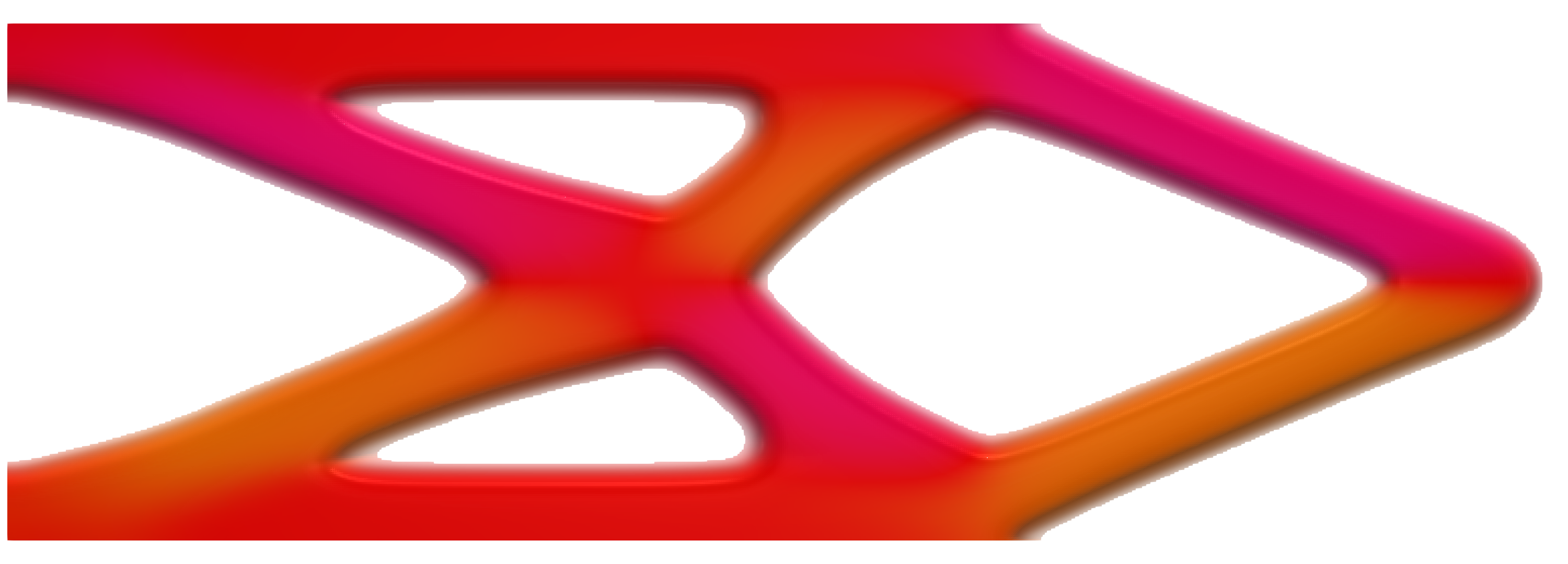
converged design — continuous fiber angle (color), volume fraction $0.5$, $h=1/256$
mesh size $h$control unknownsiterationscomplianceKKT measure
1/6436,86428$2.76\times10^{-3}$$9.1\times10^{-5}$
1/128147,45630$2.77\times10^{-3}$$9.9\times10^{-5}$
1/256589,82431$2.77\times10^{-3}$$9.7\times10^{-5}$
Brown · Applied MathMulti-Material TO via Mirror Descent

Permanent Magnet Placement

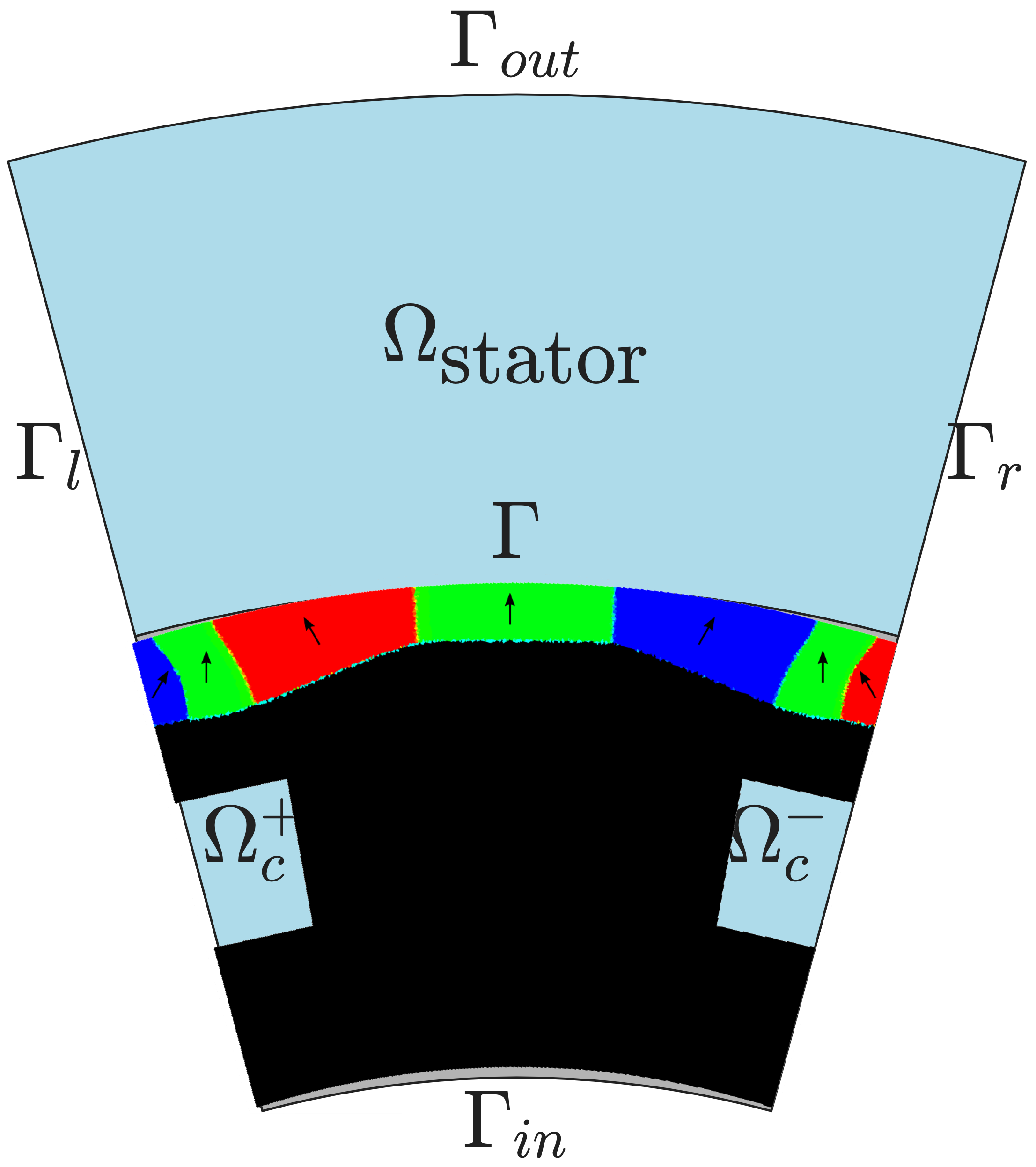
Maximize magnetic flux through the airgap:

$$ \max\ \int_\Gamma \operatorname{curl} u\cdot \mathbf{n}\,\dd s $$
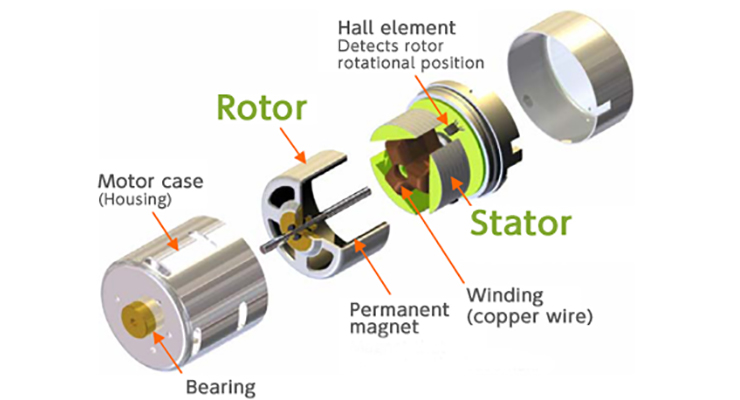
Red = permanent magnet direction, Black = iron
the device — rotor is the design domain
optimized rotor: material + orientation per point 38 it
Brown · Applied MathMulti-Material TO via Mirror Descent

Conclusion

preprint
SiMPL for physics-encoded polytopal constraints
— same algorithm, different pointwise constraint set.
  • the loop never changes — only $\nabla R^*$ is swapped
  • box, simplex, polytope, orientation polygon — one framework, feasible by construction
  • mesh-independent iterations, first-order cost
Ongoing work
  • general global constraints (min volume subject to critical compliance)(WIP)
  • robust dual solver (WIP)

Gangl, Keith, Kim, Lazarov, Surowiec — Multi-material SiMPL (2026) · builds on Keith, Kim, Lazarov, Surowiec — SIAM J. Optim. 2025 & Struct. Multidisc. Optim. 2025.

Brown · Applied MathMulti-Material TO via Mirror Descent
Thank you
Dohyun Kim · dohyun_kim@brown.edu
1 / 1

Keyboard shortcuts

/ Spacenext step / slide
previous
ffullscreen
?toggle help